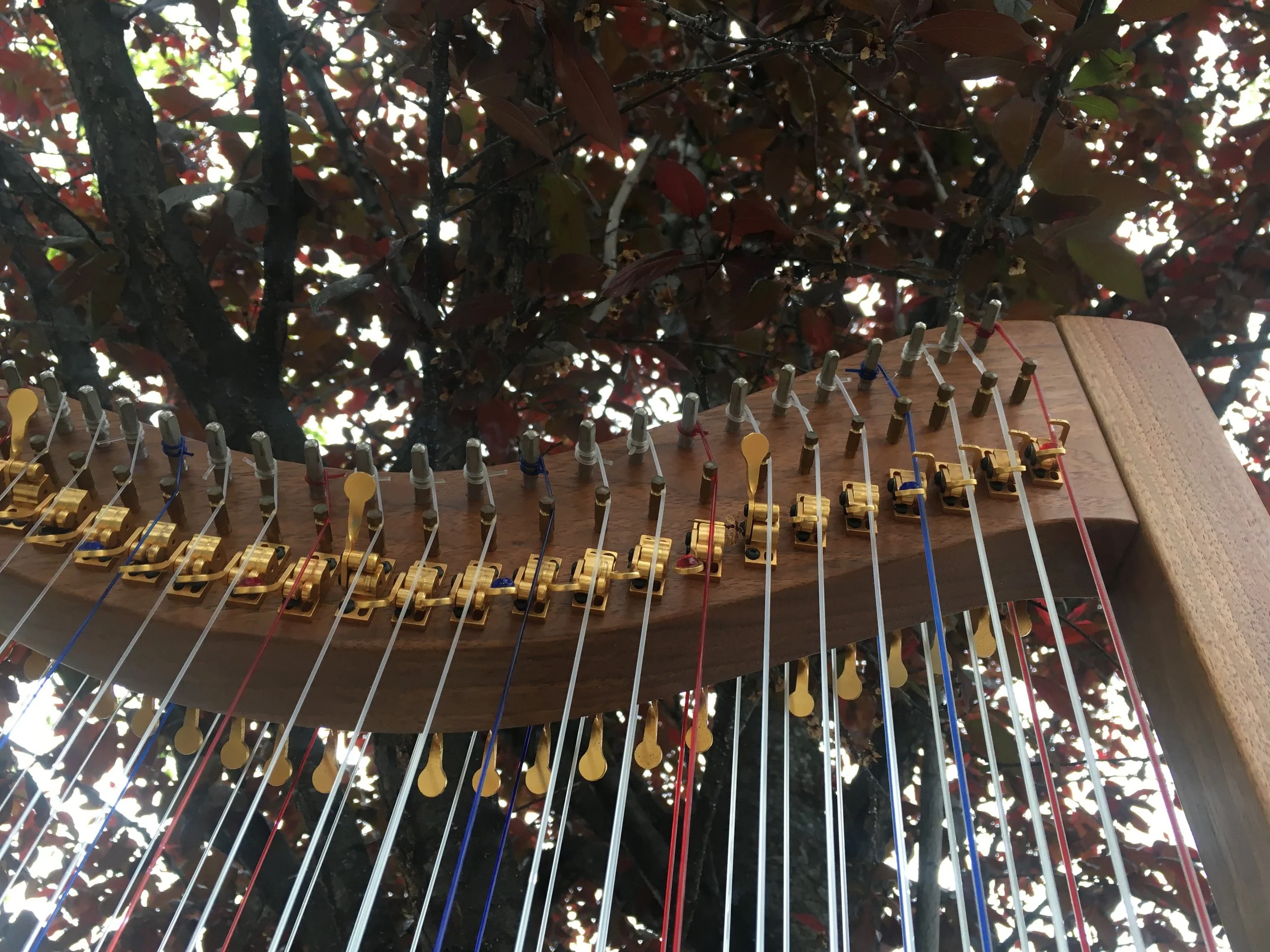

My double-strung harp was made by Don Peddle (retired), but an even better version is available from Marini Made Harps➚.
I am Karen Peterson, harp coach, workshop presenter, Certified Music Practitioner, and author of Enjoy the Modes, Enjoy the Dorian Mode, and Enjoy the Double-Strung Harp. I teach harp online via videoconference and from my home in Jersey City, NJ.
My motivation to teach
When I started attending harp conferences in 2002, I noticed that the adult students were disappointed by their progress with the harp. I admired all of these students who had picked up a brand new instrument later in life. I wanted them to be proud that they had gotten up off the couch and actually taken the steps to do something about their desire to make music. In 2012, I launched this website and began coaching students.
My goal is to help more people ENJOY THE HARP.
I hope to encourage adult students on the path they’ve chosen, either by being their teacher, by inspiring them in a workshop or a one-off lesson or two, or just by providing useful information through my writing and helpful links.
Pedal, lever, and double-strung harps
I began playing harp in 1993, the summer before my Junior year in high school. I already played violin and piano, but I hated to practice, and I wasn’t that good. I know, I know, you’d think there might be a connection between practicing and proficiency? But I knew people who were REALLY good (at least one would eventually go on to play piano in Carnegie Hall, and another became a professional violin luthier), and I knew that I did not have that kind of passion or special talent for those instruments.
Harp, however, was something that I could be impressive on with little effort. Everyone plays piano, and there are so many violins in an orchestra that they have two sections of them. But there was only one harp in the entire school district. Thus began my journey. I was trained on pedal harp by Faye Seeman➚ and then Julie Buzzelli➚. After college, I figured that a pedal harp was unattainable—too pricey, too unwieldy for a small apartment—and I also figured, “Well, you play music in school, and now school is over.” I had never wanted to be a pro anyways: I don’t like brides, I wasn’t good enough to be a studio musician, and it’s way too hard to make a living as a solo artist (this was before social media).
I went harp-less for almost as long as I had been playing. Four years later, I was surprised to find that I missed it SO MUCH. I finally went online to explore options. I had heard about lever harps, and I found out I could get a 38-string for half the price of a student-model pedal. In 2002, I went to the Somerset Folk Harp Festival➚ and played on all of the exhibitors’ harps until I found the most awesome one. A few months later, my Triplett Eclipse➚ arrived (the first one they made with Truitt levers), and I began delving into lever harp music.
Back at Somerset➚ in 2007, I wandered into a double-strung workshop. I’d seen the beautiful, narrow harps of Don Peddle➚ and figured they couldn’t possibly sound as good as they looked. I had no interest in double-strung, but I was looking for something smaller to play in a therapeutic setting. I was surprised to discover the volume and richness of the double-strung harp, and I was excited by the new opportunities afforded by two rows of strings.
I don’t miss pedal harp at all.
My favorite music to play and listen to includes early music, old-time country, campfire songs, and melodic classics from the Forties through the Eighties with an occasional contemporary tune thrown in. I love complex rhythms and interesting harmonies.
Therapeutic music
In 2008, I began courses with the Music for Healing and Transition Program➚ (MHTP), graduating in 2012 as a Certified Music Practitioner (CMP) so that I can safely and effectively play harp in healthcare. I work part-time at Cooperman Barnabas Medical Center in Livingston, NJ, playing at the bedside of patients and for staff throughout the hospital, including ICU, Neonatal ICU (NICU), Neuro ICU, Burn ICU, Cardiothoracic ICU, cardiac telemetry, cardiac step-down, renal/transplant, oncology, pulmonary, orthopedic, surgical, and all areas of the Emergency Department. I served on the Board of Directors of MHTP for nine years. See more on my site SoothingHarp.com➚.
Writing, arranging, composing
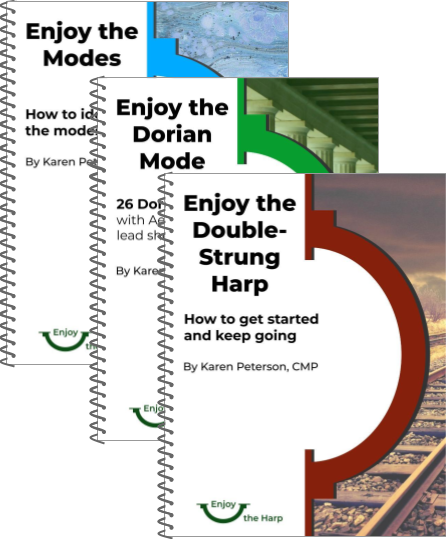
I’ve been arranging music since 2008 when I got my double-strung harp, because there is a dearth of double-strung harp sheet music. For years, I started gathering material to help double-strung students get the most out of this unique instrument, and I published Enjoy the Double-Strung Harp in 2025.
Playing therapeutically requires arranging on the fly as you adjust your music to fit the needs of the patient. And, to continue my journey of looking for shortcuts, I’ve found that it’s easier for me to make something up than to read a score. Here are a few of my double-strung arrangements. I’m working towards publishing a book of therapeutic music for all types of harps in July 2027.
One of the things I love about the harp in comparison to other instruments—especially piano—is that a major chord has the same hand shape as a minor chord for all keys. This means, for example, that you can take a piece of sheet music in A minor, set your pedals or levers to A major, and play the exact same strings and hand positions to get a totally new piece. (It’s still all about shortcuts!) I suspected that harpers could take advantage of this for the other common scale modes (Dorian, Phrygian, Lydian, and Mixolydian). After a few years of research, I published Enjoy the Modes, a 161-page instruction book for understanding the modes on the harp. Enjoy the Dorian Mode contains 26 Dorian song arrangements, each with a corresponding Aeolian and Mixolydian lead sheet to compare how these three modes are alike and different.
When I’m not doing music...
For 20 years, I worked as a technical writer➚, user interface designer, project manager, and web quality assurance coordinator for Nikon, American Express, TIAA-CREF, Dun & Bradstreet, Samsung, IBM, Sarah Lawrence College, the U.S. Government, and other companies.
I am a big proponent of enjoying the outdoors and spending the weekend at interesting spots nearby. I am currently engaged in a project where I visit every municipality in New Jersey➚, of which there are at least 934. I started in March 2025, and I’ll have completed at least 400 by July 2026. If you’re looking for something interesting to do in New Jersey, especially hiking➚, I can give you some ideas. I took the photographs➚ at the top of these pages near my home in Jersey City.
Fourth place in a field of four, second place in a field of two, first place in a field of one. The lesson? JUST SHOW UP!
I am a former Certified Personal Trainer through the National Academy of Sports Medicine, and I am a bodybuilding Women’s Physique competitor. That means that I try to build as much muscle as I can without having my veins pop out, and then I choose to be judged against other similar women on a stage. It is probably the weirdest thing that I've ever chosen to be involved in, and strangely more feminist than I would have imagined. Am I the only bodybuilding competitor who plays double-strung harp?
I served on the Board of Directors for the Music for Healing & Transition Program➚ for nine years, ending as their President, and during which time I also served on the National Standards Board for Therapeutic Musicians➚. In 2026, after 25 years as an attendee and several years as a workshop presenter, I became President of the Board of Directors for the Somerset Folk Harp Festival➚.
Ready to enjoy the harp? Contact me! You can read testimonials and find out more about my teaching style.